A Birth Abroad, Established Without the Register
A birth that was never registered, or whose register no longer exists, still left traces. Schools, clinics, religious institutions and employers all recorded the same person for their own purposes, and those records are what a substitute case is made of.
The rule in short
Secondary evidence of a birth is assembled from documents created for unrelated purposes that record the same particulars: religious entries, medical records, school enrolments, household registers and employment files. The case is strengthened by independence between sources and by proximity to the event, and weakened where every document descends from one late statement.
Establishing when and where somebody was born, without a birth certificate, is a task the systems handling it are entirely used to. The evidence exists because institutions recorded the same person repeatedly for reasons of their own, and the exercise is one of finding those records rather than of persuasion.
The usual sources, in rough order of value
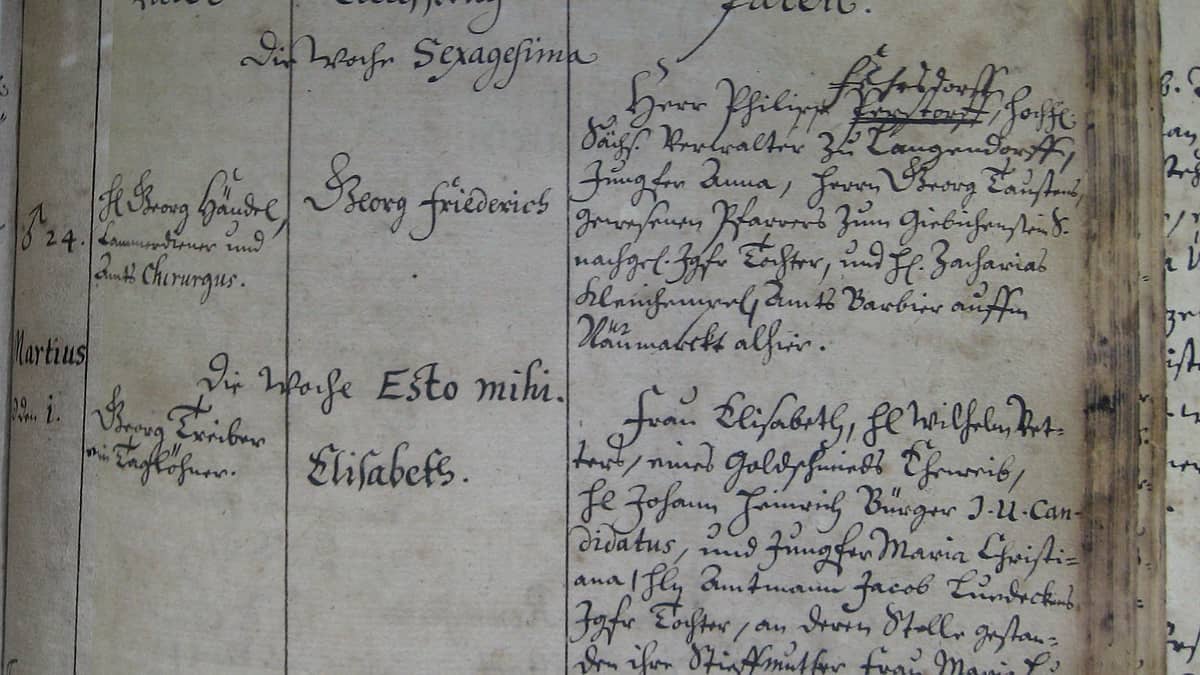
Religious registers. Baptismal and equivalent entries made within weeks of a birth, by an institution keeping its own permanent record, which makes them close to primary evidence in many countries.
Medical records. Hospital admission notes, midwife records and early vaccination cards, each created for treatment purposes at or near the time and recording a date without any interest in it.
School enrollment. Admission registers recording a date of birth supplied years before any dispute, frequently the earliest surviving official document for people born in rural areas.
Household or family registers. Where a country maintains them, they record births alongside moves and relationships, which makes them unusually informative for establishing a family as well as a date.
Employment and military records. Created when the person was already an adult and therefore further from the event, but made by institutions with their own reason to record identity accurately and to keep the entry.
What makes a substitute strong
Proximity to the birth. A record made within weeks carries far more weight than one made at eighteen, because the information came from somebody who had just witnessed the event.
Independence from other documents. A record whose information came from its own informant is a separate piece of evidence, while one copied from an earlier certificate adds nothing at all.
An unrelated purpose. Documents created for treatment, education or employment were made by people with no interest in this question, which is the feature that gives them their weight.
A named informant. Entries recording who supplied the information convert an anonymous record into a statement by an identifiable person, which can then be assessed.
Institutional permanence. A record held by a body that still exists and can confirm it on request is worth considerably more than a loose document nobody is in a position to verify, as proving that a record once existed sets out.
| Source | Typical proximity | Independence |
|---|---|---|
| Baptismal entry | Weeks | High |
| Hospital or midwife record | Days | High |
| School admission register | Five to seven years | Usually high |
| Household register | Varies | Depends on the entry |
| Affidavit written now | Decades | Low, unless it explains a document |
Assembling the file
Establish unavailability first. The correspondence showing that no civil record can be obtained comes before everything else, as when a country cannot produce the record sets out.
Trace each document to its informant. Working out where each record's information came from is what distinguishes independent sources from six copies of one late statement.
Order chronologically. A file arranged by the date each record was made, rather than by type, shows a reader immediately which documents are close to the event and which are decades away from it.
Explain each document's origin. What the institution was, why it held this information, and how the document was obtained, in a line or two each.
Add affidavits last. Statements from people who were present support the documents rather than carrying the case, and they are at their strongest where they explain a record rather than asserting a fact, as affidavits from people who knew them describes.
The strength of a substitute case is the number of independent informants behind it, not the number of pieces of paper. Establishing that four records descend from four separate statements is the single most useful thing that can be shown.
What weakens a substitute case
Every document descending from one source. A family whose papers all repeat a single late registration has one piece of evidence presented five times, and a decision-maker will say so.
Documents created recently. A record obtained last month from an institution that reconstructed it from what the applicant told them is not independent evidence of anything.
Unexplained inconsistency. Where the documents give different dates, an explanation is required, and offering only the convenient ones is worse than explaining the difference.
Missing the obvious source. A file that omits school records, where the person plainly attended school, invites the question of what those records say.
Presenting substitutes as equivalent. Claiming that a collection of secondary documents is as good as a certificate invites scepticism, whereas presenting it as the best available evidence does not.
Using the case well
State the conclusion sought. The date and place being asserted, stated plainly at the front, so that a reader knows what the documents are supposed to establish.
Show the convergence. Four independent records agreeing on a date is a strong case, and pointing out that they are independent is what makes the strength visible.
Concede the margin. Where the documents support a month rather than a day, saying so is more persuasive than asserting a precision the material does not carry.
Anticipate the alternative reading. If the documents could support a different conclusion, addressing that directly is better than leaving it for somebody else to notice.
Keep it proportionate. A substitute case does not improve with volume, and twenty documents of which fifteen are copies is weaker than five independent ones.
The exercise is more tractable than it sounds because institutions record people constantly. A person who reached adulthood almost certainly appears in a school register, a medical record or an employment file, each carrying a date somebody supplied at the time.
Independence is the property that decides the outcome. Four documents agreeing because four different people supplied the information is a strong case; four documents agreeing because they all copy one late registration is a single weak one.
Proximity comes second and is nearly as important. A record made within weeks of a birth was completed by somebody who had just seen it happen, and no later document, however formal, has that quality.
Affidavits belong in such a file and belong at the end of it. Their value lies in explaining what the documents are and how they were kept, rather than in asserting facts that the documents themselves ought to establish.
Establishing a birth without a certificate is a routine part of family immigration work, and the agencies handling it publish detailed expectations about what they will accept from each country. Where a filing depends on secondary evidence of a birth, a lawyer who petitions for parents know which combinations those agencies actually accept.
Finally, the honest framing works better than the confident one. A file offered as the best available evidence of a birth, with its limits stated, is accepted far more readily than one presented as equivalent to a certificate that does not exist.
Points to carry away
- The strongest substitutes were made for a purpose unconnected to this question.
- Proximity to the birth matters more than the formality of the document.
- Independent sources are counted; copies of one source are not.
- Affidavits support documents rather than replacing them.
- The unavailability of the primary record is established first.
Questions readers ask
Is a baptismal record as good as a birth certificate?
In many countries it is very nearly so, and in some periods it was the record. A baptismal entry is typically made within weeks of a birth, by an institution keeping a permanent register, on information from a parent, which gives it the two qualities that matter most: proximity and an independent informant. Receiving bodies generally treat such entries as strong secondary evidence, and where a country's civil registration began late, they may be the earliest official record that exists for anybody.
What if the available documents disagree about the date?
Explain the disagreement rather than selecting between the documents silently. Differences of this kind usually have ordinary causes: one record was made at the time and another from recollection, a registration default was applied, or a calendar conversion was performed inconsistently. Producing all of the documents with an explanation of which is relied on and why is considerably stronger than producing only the helpful ones, because the others will surface eventually and the selection will then be the issue.
Do affidavits from relatives carry any weight?
They do, and less than families expect when offered alone. An affidavit is a recollection produced for this filing, and a decision-maker discounts it accordingly. Its value increases sharply where it does something a document cannot: explaining who kept a record and why, describing the circumstances of a birth that was never registered, or accounting for a discrepancy between two documents. Used that way, alongside contemporaneous records, affidavits do real work.
Sources
- USCIS Policy Manual — Volume 6, Part B, Chapter 2uscis.gov
- U.S. Department of State — Visa Reciprocity and Civil Documents by Countrytravel.state.gov
- 8 CFR § 204.2 — Petitions for Relativeslaw.cornell.edu
- Federal Rules of Evidence — Rule 803, Exceptions to the Rule Against Hearsaylaw.cornell.edu
- Federal Rules of Evidence — Rule 1004, Admissibility of Other Evidence of Contentlaw.cornell.edu
- Legal Information Institute — Affidavitlaw.cornell.edu
True Justice Record is a publication, not a law firm. This article states general rules and cites its sources; it is not advice about any particular case, and the law differs by state and changes over time.
More in Documents From Another Country
Certified Translation and Who May Certify It
A certified translation carries a signed statement identifying the translator, asserting their competence in both languages, and confirming that the translation is complete and accurate. Most receiving bodies require nothing more, and no accreditation exists in many jurisdictions. What certification never does is say anything about whether the original document is genuine.

Documents From a State That No Longer Exists
When a state disappears, its records are generally inherited by a successor authority, transferred to an archive, or distributed among the states that replaced it. Identifying the current custodian is the whole exercise, and it usually has a documented answer. Where no successor holds them, the position becomes one of substitute evidence supported by a documented enquiry.
The Apostille and the Countries It Covers
An apostille is a standardized certificate issued by a designated authority in the country where a document originated, certifying the signature and seal on it. It is recognized without further steps by every other participating country. Where either country is outside the arrangement, the longer consular legalization route applies instead, and the two cannot be mixed.